RODENT CONTROL SERVICES — WICHITA, KS
Attic Cleanup in Wichita, KS
The scratching stopped months ago, but the attic still smells musty every time the furnace kicks on. The home inspector flagged droppings in the insulation. That’s the job: droppings remediation, contaminated insulation assessment, sanitization, and odor…
Licensed & Insured · 24/7 Availability · Satisfaction Guarantee
Wichita-based · 6920-6930 W Kellogg Dr, Wichita, KS 67209 · 24/7 availability · Licensed & insured (KDA license on request) · Satisfaction guarantee
What Attic Cleanup Actually Is
Attic cleanup is the remediation of a rodent-contaminated attic or crawlspace: removal of droppings and nesting material, assessment of the insulation, sanitization of affected surfaces, and treatment of lingering odor. It is the work that comes after the rodents are gone and the entry points are sealed — not a substitute for either.
There is an honest order to this, and it matters. Trapping without sealing means new rodents keep arriving Rodent Removal. Sealing without cleanup means the contamination stays — droppings in the insulation, urine-soaked nesting material, compressed batts that no longer insulate. Cleanup without sealing means you are polishing a house the mice still own. The sequence is: seal the building Rodent Exclusion, remove what’s inside, then remediate what they left behind.
Why Wichita Attics Get This Bad
This isn’t random. It’s the intersection of Wichita’s climate and its housing stock.
Every October and November, house mice and Norway rats push indoors ahead of the cold — K-State Research and Extension’s Chuck Otte describes them as “busy trying to get themselves well located for the winter,” with Wichita’s average first freeze landing on October 27. Once inside, they do what rodents do in winter: nest in the warmest, quietest void in the house, which in a Kansas winter (January averages 29°F) is the attic, the wall voids, or the crawlspace. A single winter of nesting produces a shocking volume of droppings, urine, and shredded nesting material — and it compounds year after year in homes that were never sealed.
Then add the housing. HUD data shows 51–52% of Wichita’s occupied single-family rentals were built before 1960 — the Riverside bungalows, College Hill brick colonials, Delano pier-and-beam cottages, and South Central Wichita duplexes with their aging siding, original weatherstripping, and crawlspace foundations. These homes have more entry points, more accessible voids, and decades more accumulation than a 2005 slab ranch in Derby or Maize. The Arkansas River corridor and the Wichita–Valley Center Floodway add year-round pressure to riverside neighborhoods, so attics near Riverside and the Little Arkansas corridor tend to show the heaviest long-term contamination.
The result: attics where the insulation is tunneled and compressed (destroyed R-value, higher heating bills), droppings layered through the batts, and a musty, sour odor that the HVAC system distributes through the whole house.
Signs Your Attic or Crawlspace Needs Cleanup
Trapping caught the mice. The scratching is gone. But these signs mean the contamination is still there:
- A musty or sour odor when the HVAC runs. This is the signature symptom. Mouse urine has an ammonia-like sharpness; accumulated droppings and nesting material produce a broader mustiness. If the smell spikes when the furnace or AC kicks on, the contamination is in the air path — attic or ductwork.
- Stained spots on ceilings. Urine and moisture migrating through drywall leave yellow-brown stains, sometimes mistaken for a roof leak. If the stains sit under the attic rather than under a roof valley, rodents are the likelier cause.
- The home inspector flagged droppings. This is the single most common discovery path in Wichita real estate — a buyer or seller learns the attic has a rodent history from an inspection report. Rodent evidence can stall or kill a deal, which is why cleanup is often on a closing timeline.
- Compressed, tunneled, or stained insulation. From the attic hatch: batts that look matted, blown-in insulation with visible runways, dark staining on the insulation or the joists beneath it.
- Scratching that stopped months ago — but the smell never did. Old activity leaves old contamination. The animals left; their waste didn’t.
- A fall-invasion pattern repeating yearly. Scratching every October that quiets by spring Fall Rodent Invasion usually means a fresh cohort is nesting in the same insulation each year.
If you’re seeing these, the full signs checklist is here Signs of Rodents — and the cleanup protocol detail lives in our safe-cleanup guide Safe Cleanup Guide.
Our Process: Assess, Remove, Sanitize, Treat Odor
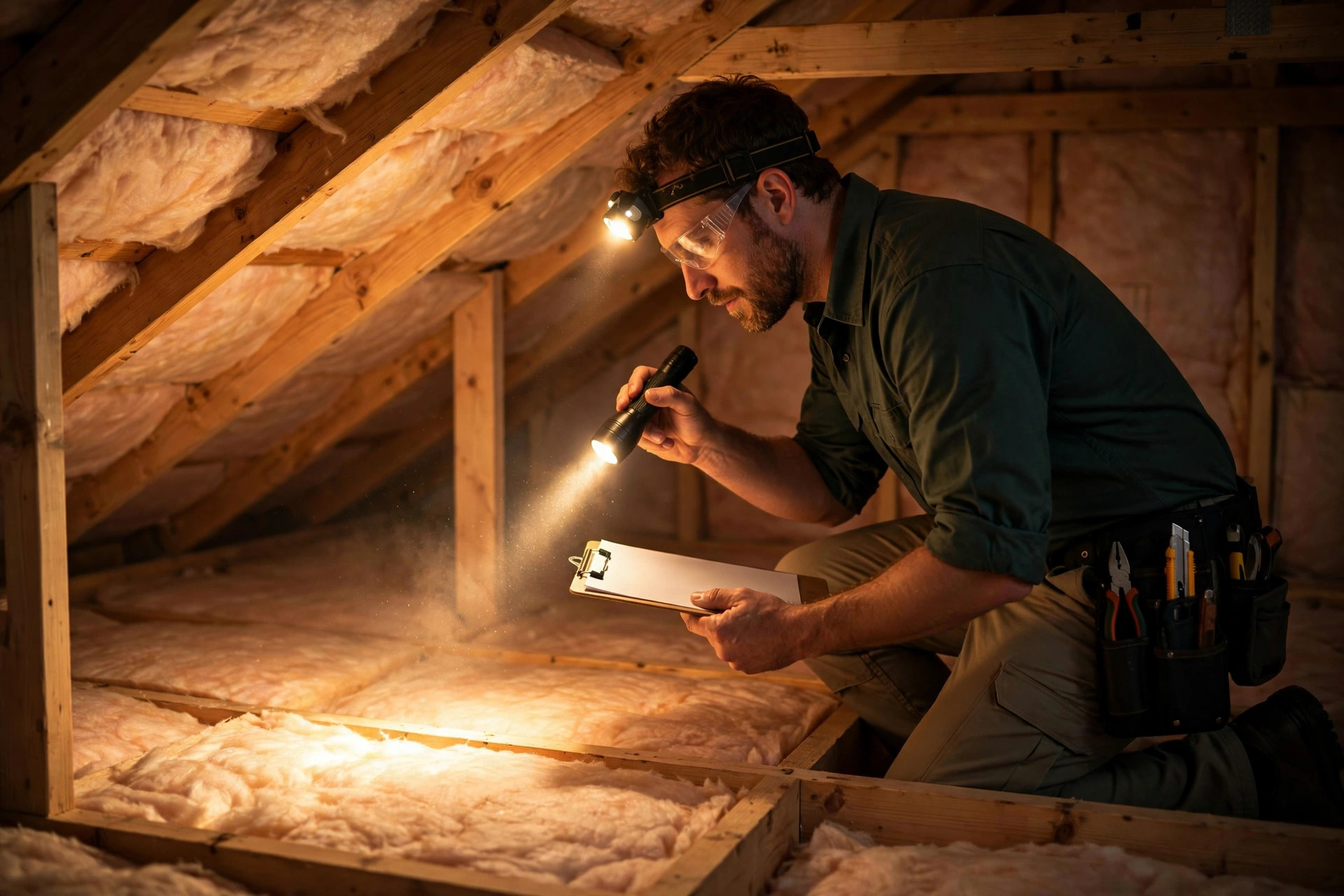
1. Inspect and document. Full attic and crawlspace inspection: droppings mapping, nesting material locations, insulation condition (compression, staining, tunneling), urine damage on framing and drywall, duct condition, and odor sources. You get the findings in plain language, with the severity ranked. No recommendation without evidence.
2. Verify the building is sealed first. This is the step the auto-sell companies skip. If entry points are still open, cleanup is cosmetic — new rodents will recontaminate the space within a season. We confirm the exclusion work is complete Rodent Exclusion before remediation begins. If it isn’t, we tell you, and the exclusion gets fixed first.
3. Remove droppings and nesting material. Per CDC cleanup protocol: no dry sweeping, no standard vacuuming (both aerosolize particles). Ventilation, respirators and gloves, disinfectant soak with adequate contact time, contained bagging and removal. Contaminated nesting material comes out; affected surfaces get wiped down, not just sprayed.
4. Assess the insulation — honestly. This is where the “assess, don’t auto-sell” rule bites. Insulation gets replaced only when it’s genuinely warranted: saturation with urine, droppings contamination throughout the batts, or R-value destroyed by compression and tunneling. Surface-level droppings on otherwise sound insulation get remediated, not replaced. We show you what we’re seeing and why, so the call is yours with real information.
5. Sanitize affected surfaces. Framing, subfloor, duct exteriors, and any surface that held contamination get disinfected. Special attention to areas over living space — a sanitized attic that sits over your bedrooms matters more than a sanitized corner over the garage.
6. Treat the odor. Odor comes from the source, not the air. With the source removed and surfaces sanitized, we treat residual odor at the material level and ventilate the space. Air fresheners and foggers that mask the smell without touching the source are the opposite of this.
7. Verify and report. Post-cleanup re-inspection, documentation of what was removed and treated, and plain-English maintenance guidance: what to watch, when to re-check, and how to keep the space clean now that the building is sealed.
What Attic Cleanup Doesn’t Do
Honest scope, in writing:
- It doesn’t stop new rodents. Cleanup remediates contamination. Only exclusion — sealing every entry point — keeps the next generation out Rodent Exclusion. Anyone selling you attic cleanup on an unsealed house is selling you a recurring subscription.
- It doesn’t fix moisture. Stained insulation from a roof leak needs a roofer, not a remediation crew. We tell you which problem you have.
- It doesn’t restore destroyed insulation by cleaning it. Compression and tunneling are physical damage; sanitizing doesn’t restore R-value. When batts are ruined, replacement is the honest recommendation — and we’ll say so.
- Pricing is a range, not a quote. There is no published Wichita-specific pricing for this work anywhere; national benchmarks for attic sanitation and insulation remediation run roughly $1,500–$8,000+ depending on attic size, contamination severity, and whether insulation is replaced. That’s a national benchmark, clearly labeled — your actual scope comes from the inspection Rodent Control Cost.
WHY CHOOSE US
From Contaminated to Clean
- ✓ Droppings and nesting material safely removed
- ✓ Sanitizing and odor treatment throughout
- ✓ Fresh insulation where the old was ruined
OUR SERVICES
More Ways We Protect Wichita Homes
COMMON QUESTIONS
Questions, Answered Honestly
Do I need to replace insulation after mice?
Not automatically — this is the most over-sold recommendation in the industry. Surface droppings on otherwise sound insulation can be remediated without replacement. Replacement is warranted when insulation is saturated with urine, contaminated throughout the batts, or physically destroyed by compression and tunneling (which also kills its R-value). An honest assessment shows you the evidence before recommending either path.
What does mouse urine smell like?
Mouse urine smells sharp and ammonia-like — distinct from the broader mustiness of accumulated droppings and nesting material. In an attic, the combination reads as a sour, stale odor that intensifies when the HVAC runs, because the system draws attic air inside. If the smell spikes every time the furnace kicks on, the contamination is in the air path.
Can mice damage HVAC ducts?
Yes — this is one of the costliest forms of rodent damage. Mice and rats chew through flexible ductwork in attics and crawlspaces, tear insulation off ducts, and nest inside disconnected runs. Damaged ducts leak conditioned air into the attic (raising energy bills) and can pull contaminated attic air indoors. Duct inspection is part of every thorough attic assessment.
Is it safe to vacuum mouse droppings?
No — never use a standard vacuum or a broom on droppings. Dry sweeping and vacuuming aerosolize particles from urine, droppings, and nesting material, which is exactly how airborne exposure happens. The CDC protocol is: ventilate the space, wear gloves and a respirator, soak the area with disinfectant for 5–10 minutes, then wipe up — wet methods only, never dry.
How many droppings mean an infestation vs a single mouse?
A single mouse produces roughly 50–75 pellets per day, so a small scattering can be one animal passing through. Thirty or more pellets concentrated in one area signals established, repeated activity rather than a wanderer. In attics, layered droppings of different ages mean multiple seasons of nesting: an infestation history, not a single mouse.
The contamination doesn’t leave when the mice do.
Every season it sits, the odor deepens and the insulation degrades further. Call (316) 205-2060 to discuss inspection options — we’ll assess your attic or crawlspace and give you an honest, written scope: what’s needed, what isn’t, and why. You can also reach us at Contact Us.
Serving Wichita, Derby, Andover, Haysville, Maize, Goddard & Sedgwick County
Kansas KDA license available on request · Satisfaction guarantee
Ready for a Rodent-Free Home?
Don’t wait for a small mouse problem to become a big one. Call now — we’re available 24/7.
Rodent Control Wichita · 6920-6930 W Kellogg Dr, Wichita, KS 67209 · Licensed & Insured
Disclosure: Rodent Control Wichita may receive a referral fee if you book service through this site.