
RODENT CONTROL SERVICES — WICHITA, KS
Rodent Exclusion in Wichita, KS
Traps catch the mice that are already inside. Exclusion seals the doors they came through. In Wichita’s pre-1960 housing stock — Riverside bungalows, College Hill brick streets, Delano pier-and-beam cottages — exclusion isn’t an upgrade. It’s the whole game.
Licensed & Insured · 24/7 Availability · Satisfaction Guarantee
Wichita-based · 6920-6930 W Kellogg Dr, Wichita, KS 67209 · 24/7 availability · Licensed & insured (KDA license on request) · Satisfaction guarantee
Why Traps Alone Fail (and What Works Instead)
Exclusion is the permanent sealing of every entry point a rodent can use — the opposite of extermination, which only removes the animals already inside. K-State Research and Extension’s Chuck Otte has a rule for this: “if you can get the start of your little finger into a gap, a mouse can go through it.”
Here’s the honest arithmetic. A house mouse fits through a 1/4-inch gap. A typical Wichita bungalow — say, a 1940s pier-and-beam in Riverside with its original siding — can have a dozen such gaps: the foundation-siding junction, an uncapped dryer vent, utility penetrations where the AC lines enter, garage door corners that never quite sat right. Trap and kill every mouse inside and the building is quiet for a few weeks. Then new mice, driven in by the October cold snaps and the average first freeze on October 27, follow the same grease-marked runways back in.
“Seal first, then trap what is left inside. Trapping first means you are removing mice while the door stays open.” That line belongs to a Wichita competitor, and it’s the truest sentence in the local pest industry. We practice it in exactly that order: seal, then trap what’s sealed in.
Exclusion is the one rodent service that reduces your future spend instead of recurring it. A trapping-only program with no sealing is a subscription to your own problem.
Exclusion vs. Extermination — The Comparison
| Exclusion | Extermination | |
|---|---|---|
| What it does | Seals every entry point so rodents can’t enter | Kills or removes the animals already inside |
| Result | Permanent — the building becomes unavailable to rodents | Temporary — new rodents follow the same gaps back in |
| Time horizon | One project, results measured in years | Recurring, seasonal, effectively forever |
| Best analogy | Fixing the leak | Bailing water |
| When you need it | Always — as the first step | Always — as the second step, after sealing |
| Typical Wichita fit | Pre-1960 homes in Riverside, College Hill, Delano, South Central | Heavy infestations where animals are already inside walls/attics |
You almost always need both — but in that order. Rodent Removal
The Entry-Point Hierarchy — Where Mice and Rats Actually Get In
After mapping entry points across Wichita homes, the gaps fall into a clear order of frequency. Start at the top of this list; most houses yield their secrets by item four.
1. Foundation-siding junction. The line where your siding meets the foundation or sill plate. On pre-1960 homes — the HUD-documented 51–52% of Wichita single-family rentals built before 1960 — settling, moisture, and 70 years of freeze-thaw have opened this joint. It’s the #1 mouse door in Riverside and College Hill bungalows.
2. Utility penetrations. Where water, gas, electrical conduit, and AC refrigerant lines pass through walls and foundations. The holes were drilled oversized (they always are) and the original caulk cracked decades ago. Norway rats widen these with gnawing — a half-inch gap is all a brown rat needs.
3. Dryer vents. Uncapped or damaged dryer vents are heated mouse doors — warm, dark, and often terminating in a laundry room. Wire vent screens (not plastic) are the fix.
4. Garage door corners. The bottom corners of garage doors rarely seal flush, especially on older slab and pier-and-beam garages in Delano and South Central. Mice walk straight under. Brush-style door seals fix what weatherstripping can’t.
5. Soffits and rooflines. Squirrels aren’t the only climbers — mice scale brick, siding, and downspouts. Gaps at the eave-soffit joint, damaged fascia, and rooflines where branches touch the house are aerial entries. Trim branches back 6 feet from the roof.
6. Weep holes. Those small slots in brick veneer exist for drainage. Mice know this. Weep-hole covers (not caulk — the wall needs to breathe) keep rodents out without trapping moisture.
7. Attic vents and gable screens. Standard vent screens deteriorate. Rodents gnaw through old mesh. Replacement with 1/4-inch hardware cloth is permanent.
8. Sill plates, kick plates, and cabinet voids. Interior-side gaps that let rodents move between wall voids and living space — behind refrigerators, under kitchen cabinets, around pipe escutcheons. These get sealed last, after the exterior is tight, so you don’t trap rodents in the walls.
The daylight test finds what your eyes miss: on a dark day, kill the lights in the basement or crawlspace and look for daylight streaming through the sill band. Every streak of light is a door. We also use tracking patches — flour or chalk dust near suspected gaps — to read runways like footprints. Rodent Proofing Guide
Materials That Actually Work (and One That Doesn’t)
| Material | Best for | Verdict |
|---|---|---|
| Copper mesh | Packing into gaps before sealing | Best general-purpose. Rodents can’t chew it; it never rusts. The pro standard. |
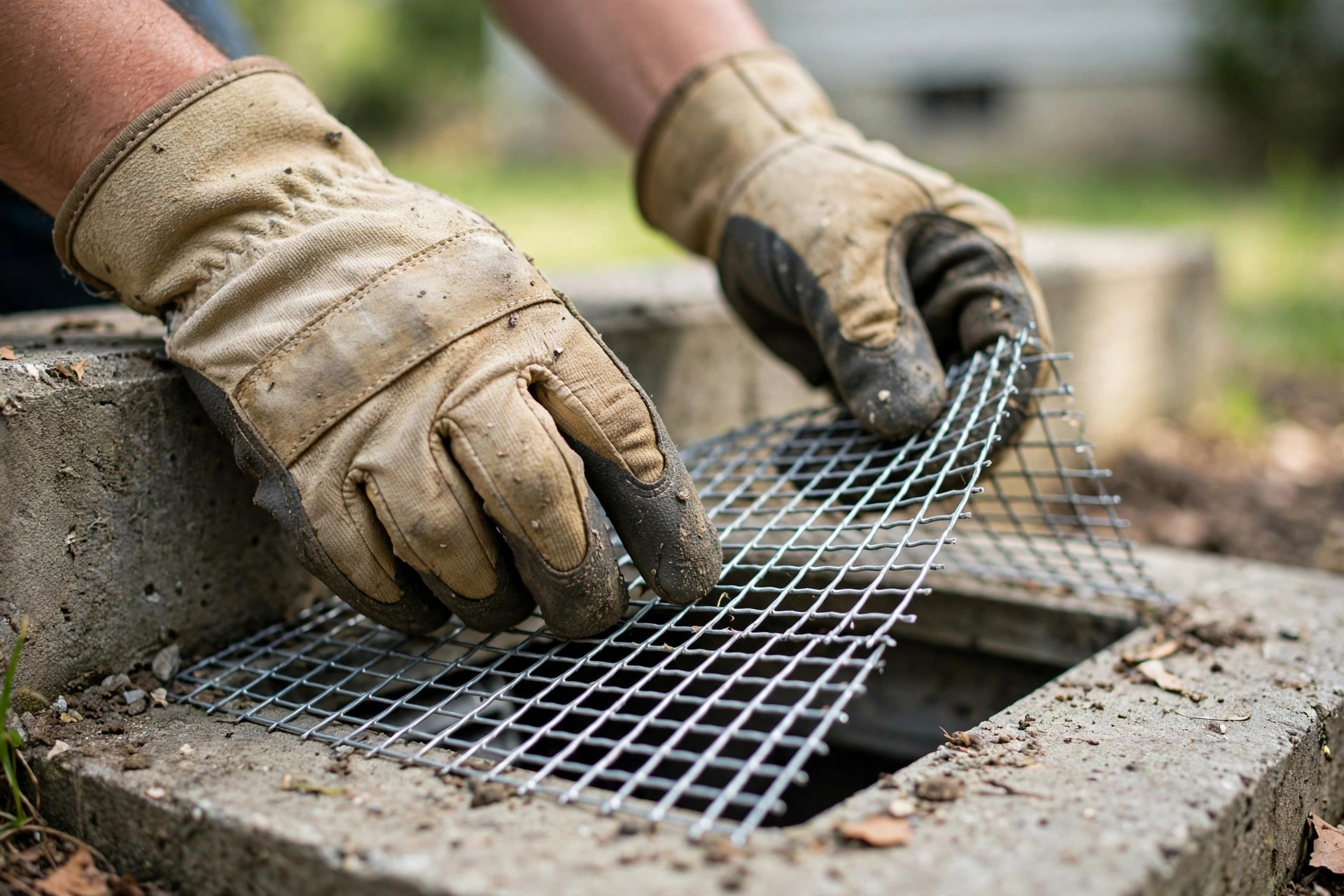
| 1/4-inch hardware cloth | Vents, weep holes, large openings, attic screens (mice) | Permanent. Rigid, chew-proof, breathable. |
| 1/2-inch hardware cloth | Larger gaps, burrow-exclusion, rat-focused work | Right for Norway rats; too coarse for mice alone. |
| Steel wool | Quick gap packing | Temporary. Mice hate chewing it, but it rusts and degrades — especially in Wichita’s humid seasons. Copper mesh is the upgrade. |
| Caulk / sealant | Sealing over metal barriers; weatherstripping | Essential finish layer — but never the barrier itself. |
| Door sweeps / brush seals | Garage doors, entry doors | Fixes the bottom-corner gap that defeats most DIY. |
| Spray foam alone | Nothing | Fails. Mice chew straight through it. Foam is insulation, not a barrier. |
The rule is five words: metal first, sealant second. Every permanent seal in a Wichita home follows it — copper mesh or hardware cloth packed into the gap, then caulk or foam over it. Any contractor who wants to foam-only your gaps is selling you the problem back.
Pre-1960 Wichita Homes Need a Different Plan
More than half of Wichita’s occupied single-family rentals were built before 1960 (HUD). In neighborhoods like Riverside, College Hill, Delano, and South Central Wichita, that means pier-and-beam and crawlspace foundations, clapboard and asbestos-shingle siding, original windows and weatherstripping, and mature tree canopy that reaches the rooflines.
This is the city’s highest structural vulnerability to rodents — and it needs a heavier exclusion plan than a 2005 slab ranch in Derby:
- More entry points. Seventy-plus years of settling opens joints that didn’t exist when the house was built. A pre-1960 bungalow routinely needs twice the sealing points of a newer home.
- Crawlspace access. Pier-and-beam foundations mean the underside of the house is open air. Vent screens, access-door seals, and under-sill gaps all need hardware cloth — and someone willing to crawl it.
- Tree canopy. Mature oaks and elms in Riverside and College Hill give roof rats’ absence meaning: it’s house mice using the branches. Trim 6 feet back.
- Brick streets, brick veneer. College Hill’s brick construction means weep holes and mortar joints — specialized, but routine for an exclusion crew.
A 2005 Derby slab ranch is a different job: garage door corners, utility penetrations, weep holes — half a day, often. An honest quote explains the difference. Rodent Control Cost
Our Exclusion Process
1. Inspect. Full perimeter walk plus attic and crawlspace check. We map every gap with the daylight test, tracking patches, and the pencil test — if a pencil fits, a mouse fits. You get the map: every entry point, photographed, ranked by severity.
2. Seal. Each gap gets the right material from the table above. Copper mesh and hardware cloth go in first; sealant goes over. Door sweeps, vent screens, weep-hole covers, metal flashing at the foundation-siding junction — all rodent-rated, all permanent.
3. Verify. Tracking patches stay down to confirm no new activity. We re-walk the perimeter, check the seals are holding, and confirm the attic is quiet. A sealed house in October is a quiet house in January.
4. Maintain. We tell you what to watch: reseal caulk lines as they age, keep branches trimmed, keep the garage door adjusted. Exclusion holds for years when the materials are right.
Trapping the mice already inside happens after sealing — Rodent Removal — so we’re removing residents, not new arrivals.
What Exclusion Doesn’t Fix
Honest scope matters. Exclusion stops entry. It doesn’t clean what’s already fouled: droppings in the attic, compressed and contaminated insulation, nesting material in wall voids, the musty odor that lingers after the animals are gone. That’s attic and crawlspace remediation — a different service with different pricing Attic & Crawlspace Cleanup. And exclusion doesn’t fix food attractants: pet food left out, open trash, bird feeders near the foundation. We’ll tell you about those during the inspection, whether you hire us or not.
WHY CHOOSE US
Sealed With Steel, Not Just Traps
- ✓ Galvanized steel mesh over vents, gaps, and rooflines
- ✓ Door sweeps and weatherstripping that mice can’t chew through
- ✓ A mapped, guaranteed seal — not a monthly spray
OUR SERVICES
More Ways We Protect Wichita Homes
COMMON QUESTIONS
Questions, Answered Honestly
How small of a hole can a mouse get through?
A mouse fits through a 1/4-inch gap — about the width of a pencil. K-State Extension’s Chuck Otte puts it this way: “if you can get the start of your little finger into a gap, a mouse can go through it.” Rats need only a 1/2-inch gap. This is why the foundation-siding junction and utility penetrations matter more than any trap.
Will steel wool keep mice out?
Temporarily, but it rusts and deteriorates — especially in Wichita’s humid seasons — leaving the gap open again. Copper mesh is the professional upgrade: rodents can’t chew through it and it never rusts. The permanent method is packing the gap with copper mesh or 1/4-inch hardware cloth first, then sealing over it with caulk.
Can mice chew through spray foam?
Yes — mice chew straight through spray foam. Foam is insulation, not a barrier, and foam-only “sealing” is one of the most common reasons exclusion fails. The correct sequence is metal first, sealant second: pack the gap with copper mesh or hardware cloth, then cover it with caulk or foam.
Where do mice get into houses?
The most common entries, in order: the foundation-siding junction, utility penetrations (water, gas, AC lines), dryer vents, garage door corners, soffits and rooflines, weep holes in brick veneer, and attic vent screens. In Wichita’s pre-1960 neighborhoods like Riverside and College Hill, the foundation-siding junction is entry point number one.
Should I seal entry points in winter or wait?
Seal in early fall — don’t wait for winter. Wichita’s average first freeze is October 27, and K-State Extension notes mice and rats are “busy trying to get themselves well located for the winter” through October and November. Sealing in September puts the barrier up before the invasion peaks. By the first measurable snow (average December 2), exclusion is urgent rather than preventive.
The mice are scouting your house right now. Seal it before October 27.
Every gap sealed this fall is a quiet winter. Call (316) 205-2060 to discuss inspection options — we’ll map your entry points and give you a straight, written plan.
Ready for a Rodent-Free Home?
Don’t wait for a small mouse problem to become a big one. Call now — we’re available 24/7.
Rodent Control Wichita · 6920-6930 W Kellogg Dr, Wichita, KS 67209 · Licensed & Insured
Disclosure: Rodent Control Wichita may receive a referral fee if you book service through this site.